La Pensée sauvage
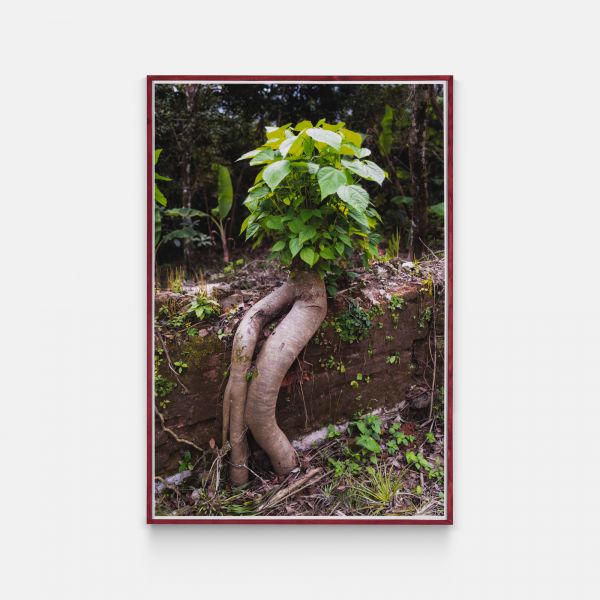
Diana, 2024
Color photograph, C-print on Fuji mat paper, frame from recycled wood
120 x 81,5 cm
Edition of 3
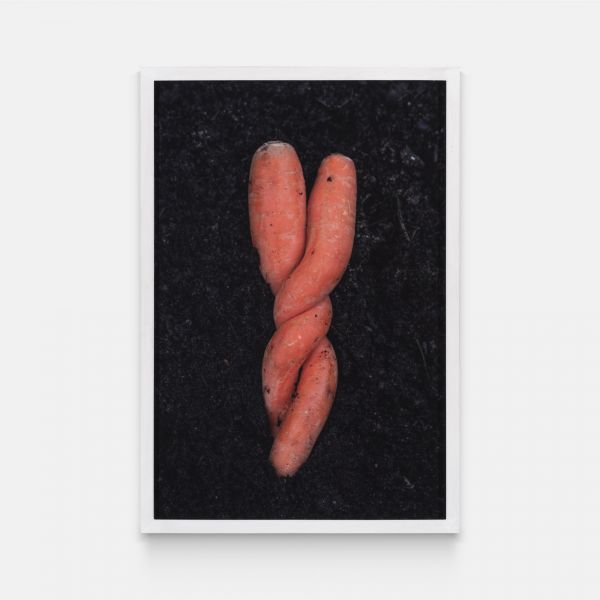
I Do Not Want to Die Alone, 2024
Color photograph, C-print on Fuji mat paper, frame from recycled wood
35 x 23,5 cm
Edition of 3
This series of anthropomorphic plants subverts the cultural hegemony of the human gaze. Is it only when natural patterns rehearse human conditions that one can relate to them? In this series, the artist encounters creatures that ‘speak to us’ in a non-verbal expression, plants whose shape is so striking that one cannot help but surrender to them and listen. However, they are plants, and this automatically dissolves human attributes, and, as such, gender qualities. Where one might see Diana as a woman sitting on a curb, others might perceive a man with wild hair. The poly-gendered carrots, unwilling to die alone, unite beyond binary identities. In this game of projection, it is the viewer who imprints their reading. Thus, the dialogue becomes active; the plantsquestion our subjective gaze, yet they remain independent from our (mis)conceptions.
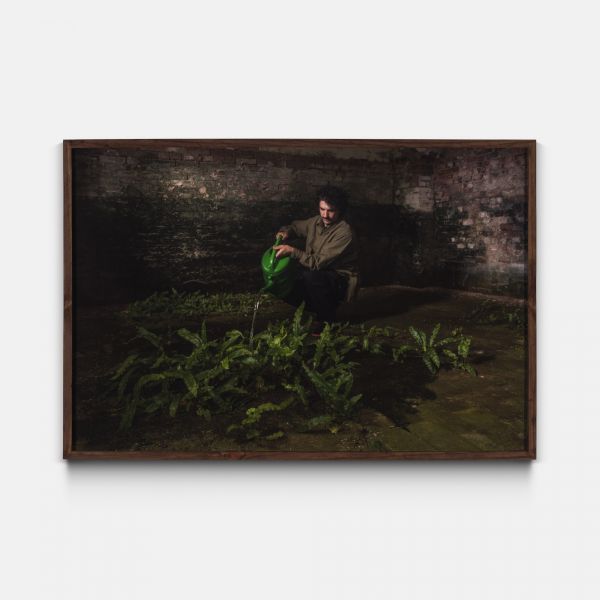
Houseplants, 2024
Color photograph, C-print on Fuji mat paper, frame from recycled wood
50,5 x 74,5 cm
Edition of 3
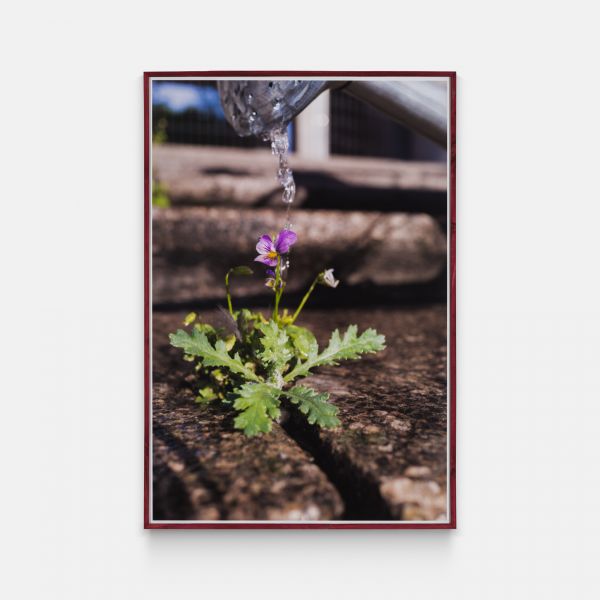
La Pensée Sauvage, 2024
Color photograph, C-print on Fuji mat paper, frame from recycled wood
119,5 x 81,5 cm
Edition of 3
La Pensée Sauvage, a photograph taken during the development of the Weed Care action. The image of the flower bursting through the pavement supported by a hand in solidarity, stands as a singular piece. In French, the Wild Pansy is known as “La Pensée Sauvage,” [The Wild Thinking] a feminine noun. This title echoes Claude Lévi-Strauss’s seminal work, where he urges us to question the dominance of science in modern knowledge systems. Lévi-Strauss argues that alongside rationality, magical thinking has shaped human cultures, offering complementary modes of understanding the world; it is through analogies and metaphors that rationality and wonder converge. While rational thought encounters its limits in grasping the full scope of reality, magical thinking illuminates new paths of possibility, inviting perspectives anew. Missika’s oeuvre thrives in this liminal space, where conventional reality intersects with alternative forms of non-human knowledge.
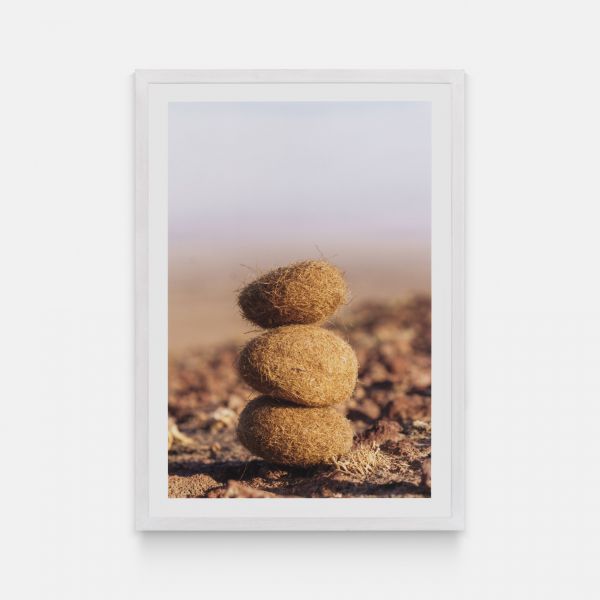
Objets dépaysés (series) Three Neptun Balls, 2024
3 Corsican Aegagropila on Inner Mongolia volcano rocks
Color photograph, C-print on Fuji mat paper, frame from recycled wood
35 x 25 cm
Edition of 3
In Objets dépaysés (series), Missika relocates a series of natural objects, an act of forcibly displacing something rooted in one environment. In Greek, “metaphor” [μεταφορά] means transport, transfer, or moving something from one place to another. In this case, the artist transports a set of Neptune balls, the seagrass fibers compacted by the waves of Corsica are carried to the volcano of Wulanhada in Inner Mongolia. The seaweed has been previously shaped by the movement and friction of the sea, resulting in a pebble-like form that now lies atop an ancient volcano. Like a metaphor, the object is dé-paysé [out-of-theordinary], first transformed by the water, then, by the artist, who follows the inertia of the action until it lands amid an otherworldly landscape. This sequence of be- wildering events dissolves the dichotomy of ‘natural’ and ‘artificial,’ serving as well as a metaphor for the displacement of both humans and non-humans, the denaturalization of plants, and the globalization of species. This disruptive action culminates in the creation of a landscape milestone: These stacks are cairns, often used worldwide as landmarks to indicate summits or hiking trails. Missika completes the human-made mineral towering shape with vegetal pebbles adorning the pile. Consequently, the chain of movement may continue; this time, it will be the wind that determines the next journey of what now has become a tumbleseaweed.


